Staff Direct: Facilities Maintenance Operative Jobs in Southampton for Commercial Building Maintenance Covering Multiple Trade Skills Including Plumbing Carpentry and Minor Electrical Work in Office and Retail Environments
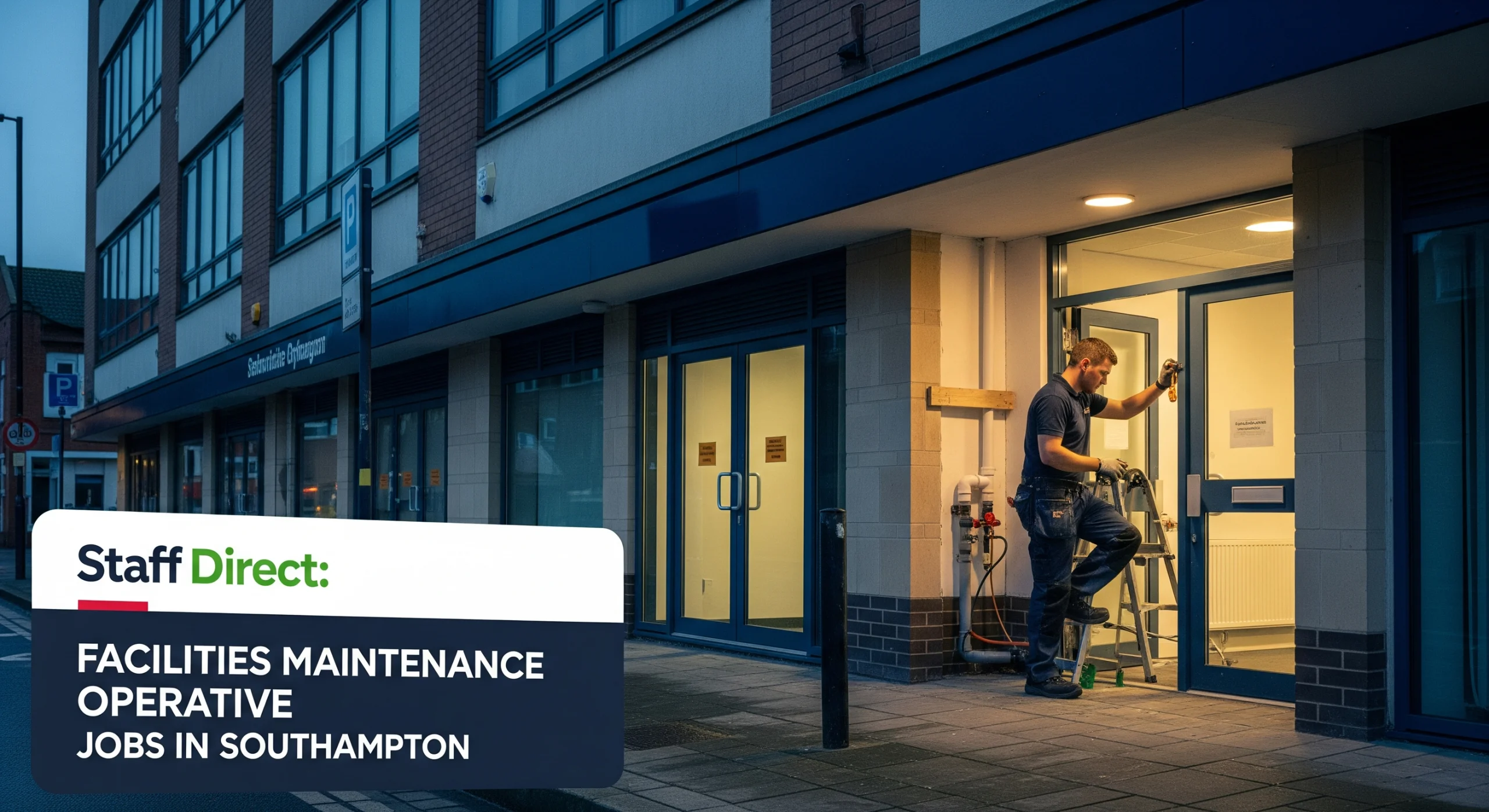
If you’ve ever walked into a bustling office in Southampton’s city centre or browsed the shops at Westquay and noticed everything just… works, you’ve witnessed the silent success of a Facilities Maintenance Operative. The lights don't flicker, the taps don't drip, and the doors close properly. It’s not magic; it’s the hard work of skilled tradespeople who keep the commercial heart of Southampton beating.
At Staff Direct , we know that finding the right role in facilities management isn't just about matching a CV to a job description. It's about finding that sweet spot where your skills in plumbing, carpentry, and electrical work meet a company that values reliability. If you are looking for Facilities Maintenance Operative jobs in Southampton , specifically within commercial building maintenance covering multiple trade skills, you are in the right place.
This guide dives deep into what these roles entail, why Southampton is a prime location for this work, and how Staff Direct can help you land your next big contract.
The Role: What is a Facilities Maintenance Operative?
Let’s cut through the jargon. A Facilities Maintenance Operative (often called a "multiskilled maintenance tech" or "handyperson") is the Swiss Army Knife of the building world. You aren't just a plumber, and you aren't just a carpenter. You are the person who fixes the problem, whatever it happens to be.
In the context of commercial building maintenance , you are responsible for the upkeep of business premises. Unlike residential work, where you might be dealing with a homeowner's leaky radiator, commercial work involves maintaining office blocks, retail parks, warehouses, and public buildings.
The "Multi-Trade" Requirement
Employers in Southampton are rarely looking for a specialist who only does one thing. They need agility. The core of these roles usually revolves around three key pillars:
- Plumbing: We aren't talking about installing a whole new heating system from scratch. This is usually maintenance plumbing. Think unblocking commercial toilets, fixing leaking taps in office kitchenettes, replacing siphons, or dealing with radiators that won't heat up.
- Carpentry: This is often "fabric maintenance." It involves repairing door closers (a huge one in commercial spaces), fixing broken desks, hanging whiteboards, repairing skirting boards, or securing loose floor tiles.
- Minor Electrical Work: Safety is paramount here. You usually won't be rewiring a building, but you will be changing ballasts, replacing light fittings, swapping out damaged sockets, and performing PAT testing (Portable Appliance Testing).
The Environment: Office vs. Retail
At Staff Direct, we recruit heavily for both sectors, and they are quite different beasts.
- Office Environments: These are usually 9-to-5 hubs. The work here is about being invisible. You fix things without disrupting the workflow. Professionalism and communication skills are key because you’ll be interacting with office managers and staff.
- Retail Environments: This is faster-paced. If a changing room door is broken or the AC goes down in a shop, it directly affects sales. You might be working out-of-hours or dealing with high footfall areas where health and safety barriers are your best friend.
Why Southampton? The Hub of the South Coast
Why look for maintenance work in Southampton specifically? Honestly, the city is booming. As a major port city with a massive retail catchment area and a growing business district, the demand for facilities maintenance is incredibly high.
The Commercial Landscape
Southampton isn't just a cruise terminal. It’s home to major employers, large shopping centres like Westquay and The Marlands, and countless office parks on the outskirts like Chilworth or near the airport. Every single one of these buildings requires ongoing, preventative, and reactive maintenance.
This density of commercial property means:
- Job Security: Buildings always break. Maintenance is recession-proof.
- Variety: One day you could be in a high-rise office block near Ocean Village, and the next you’re in a retail unit on the High Street.
- Competitive Pay: Because skilled multi-traders are in demand, rates in Southampton are competitive compared to the rest of the UK, often matching London fringe rates without the commute.
Key Skills You Need to Succeed
When we vet candidates at Staff Direct, we look beyond the NVQ certificates. Yes, qualifications matter, but attitude is everything in facilities maintenance.
1. The "Can-Do" Attitude
It sounds cliché, but it’s true. In this job, you might turn up to fix a light and find a leak in the ceiling. You can't just say, "Not my job." You need to be the person who isolates the water, makes the area safe, and figures out the next step.
2. Problem Solving
Commercial buildings are complex. You need to look at a problem—like a door that won't lock—and figure out if it’s the hinge, the frame, or the lock barrel. You need to be a detective before you pick up your tools.
3. Health & Safety Awareness
This is non-negotiable. In a commercial environment, you are liable not just for your safety, but for the public and the staff around you. You need to know your RAMS (Risk Assessments and Method Statements) inside out. Working at height, COSHH (Control of Substances Hazardous to Health), and electrical safety knowledge are vital.
4. Technical Qualifications
While "handy" is good, "qualified" is better. Employers love to see:
- City & Guilds or NVQ Level 2/3 in a primary trade (Plumbing, Electrical, or Carpentry).
- 18th Edition wiring regulations (for electrical bias roles).
- IPAF/PASMA licences for working at height (using cherry pickers or scaffolding towers).
- L8 Legionella Awareness (crucial for water hygiene in offices).
A Day in the Life of a Maintenance Operative
What does a typical Tuesday look like for a Staff Direct candidate in Southampton? Let’s break it down.
08:00 AM: You arrive at an office complex in Southampton City Centre. You check in with the Facilities Manager and pick up your PDA (handheld device) to see your jobs for the day.
08:30 AM: First job: A report of a "burning smell" in a 2nd-floor meeting room. You investigate and find a faulty ballast in a fluorescent light. You isolate the power, replace the fitting with a new LED panel (an upgrade!), and test it. Job closed.
10:00 AM: You head to the breakout area. The cupboard door under the sink has come off its hinges. A quick carpentry fix. You re-screw the hinge plate and adjust it so the door sits flush.
11:30 AM: Emergency call. A toilet is blocked in the reception area. It’s not glamorous, but it’s essential. You use your plumbing skills to clear the blockage and sanitise the area.
01:00 PM: Lunch.
02:00 PM: Planned Preventative Maintenance (PPM). You have a schedule to check all the fire doors in the East Wing. You check the gaps, the seals, and the closers. Two closers are slamming shut too fast; you adjust the tension to ensure they close safely.
04:00 PM: You’re sent to a retail unit nearby where a shelf has collapsed in the stockroom. You secure new brackets into the masonry wall, ensuring it can hold the weight.
05:00 PM: You log all your jobs on the system, report any parts that need ordering, and head home.
Reactive vs. Planned Maintenance: Understanding the Split
When applying for jobs through Staff Direct, you’ll often see terms like Reactive Maintenance and PPM (Planned Preventative Maintenance). Understanding the balance is key to knowing if a job suits you.
Reactive Maintenance
This is "firefighting." Something has broken, and you need to fix it now . This requires a calm head under pressure. If a pipe bursts in an server room, you don't have time to ponder; you act. This type of work is exciting and varied but can be stressful.

Planned Preventative Maintenance (PPM)
This is the routine stuff that stops things from breaking in the first place. It involves:
- Emergency light testing (the "flick test").
- Checking tap temperatures (Legionella control).
- Inspecting HVAC filters.
- Checking door mechanisms.
Most Facilities Maintenance Operative roles in Southampton will be a mix of both. A common split is 70% PPM and 30% Reactive.
Working with Staff Direct: Why Choose Agency Work?
There’s a misconception that agency work is just for people who can't get permanent jobs. That is miles from the truth in the construction and facilities sector. Here is why many top-tier tradespeople choose Staff Direct:
Flexibility
Want to work flat out for six months and then take a month off to travel? Agency work allows that. You aren't tied to a single employer forever.
Variety of Experience
If you are newly qualified or looking to broaden your skill set, agency work is a goldmine. You might spend three months in a hospital, then move to a university, then to a retail park. This builds a CV that screams "adaptable."
"Try Before You Buy"
Many of our temporary positions lead to permanent contracts. It’s a great way for you to test out a company and see if you like their culture before committing to a long-term contract.
We Do the Legwork
Job hunting is boring. Updating your CV is tedious. At Staff Direct, we handle that. You tell us your skills, your desired rate, and your location preference, and we find the matches. We have direct lines to the hiring managers at some of Southampton's biggest facilities management companies.
The Staff Direct Application Process
So, you’re interested. How do you get from reading this article to fixing a sink in Southampton?
- Registration: Submit your CV to us. Make sure you highlight your multi-trade skills. Don't just write "maintenance." Write: "Proficient in copper pipework, hanging doors, and changing electrical faceplates."
- The Vetting: We will call you. We want to hear about your experience. We aren't just ticking boxes; we want to know if you prefer working in a team or solo, and if you have a valid driving licence (crucial for mobile roles).
- Compliance: We need to see your certificates. CSCS cards, City & Guilds, and rights to work in the UK.
- The Match: When a job comes in—say, a Facilities Maintenance Operative for a large retail chain in Westquay—we send your profile over. Because we’ve vetted you, the client trusts our recommendation.
- The Interview/Start: Sometimes it’s an interview; sometimes, for short-term cover, it’s an immediate start.
Salary Expectations in Southampton
Let’s talk money. Compensation for Facilities Maintenance Operatives in Southampton is competitive.
- Entry Level / Assistant: If you have one trade but are learning others, you might look at 24 , 000 − 28,000 per annum.
- Experienced Multi-Skilled: For a solid all-rounder with 5+ years of experience, salaries range from 30 , 000 − 36,000 .
- Senior / Lead Technician: If you manage other operatives or have specialist certifications (like extensive HVAC or high-voltage electrical), you can command 38 , 000 − 45,000+ .
Note: Contractor/Agency rates are often calculated hourly. Depending on the complexity, this can range from 16 t o 22+ per hour.
Tools of the Trade: What Do You Need?
For most mobile or site-based roles found through Staff Direct, the employer provides the heavy equipment and power tools. However, a professional operative usually has their own comprehensive hand tool kit.
The Essentials:
- VDE Screwdrivers: For electrical safety.
- Adjustable Spanners & Grips: For plumbing fittings.
- Continuity Tester / Multimeter: For basic electrical fault finding.
- Cordless Drill: The most used tool in the box.
- Spirit Level & Tape Measure: Because "eyeballing it" isn't professional.
Having your own well-maintained kit shows employers you are serious and ready to work immediately.
Challenges of the Job
We believe in honesty at Staff Direct. This job isn't always easy.
- The "Invisible" Factor: People usually only notice facilities management when it goes wrong. You rarely get thanked for the 100 days everything worked perfectly, but you will hear about the one day the air conditioning failed. You need a thick skin.
- Physical Demands: You will be on your feet all day, climbing ladders, crawling into ceiling voids, and lifting materials. It keeps you fit, but it is tiring.
- On-Call Rotas: Many commercial maintenance contracts require 24/7 cover. You may be required to be on an "on-call" rota one week in every four, meaning you could be called out at 2 AM for an emergency.
However, for those who love variety and hate sitting at a desk, the pros far outweigh the cons.
Future-Proofing Your Career
The world of facilities maintenance is changing. To stay ahead of the curve in Southampton, consider upskilling in these areas:
- Smart Buildings: Offices are getting smarter. Lighting and heating are controlled by complex BMS (Building Management Systems). Learning how to navigate these software interfaces is a huge plus.
- Green Technology: Sustainability is massive. Knowledge of heat pumps, solar PV maintenance, and EV charging point installation/maintenance will make you incredibly employable in the next decade.
Conclusion: Ready to Fix Southampton?
Southampton is a vibrant, growing city that relies on skilled tradespeople to keep moving. Whether it's ensuring the water runs in a busy high street shop or keeping the lights on in a corporate headquarters, Facilities Maintenance Operatives are the unsung heroes of the commercial world.
If you have the skills—the plumbing know-how, the carpentry finesse, and the electrical competence—and the right attitude, Staff Direct wants to hear from you. We bridge the gap between talented operatives and the best employers in the region.
Don't settle for a job that doesn't challenge you. Step into a role that offers variety, stability, and the satisfaction of a job well done.
Contact Staff Direct today to discuss current Facilities Maintenance Operative vacancies in Southampton.
Frequently Asked Questions (FAQs)
1. Do I need to be fully qualified in all three trades (Plumbing, Carpentry, Electrical) to apply?
No, you don't need to be a master of all three. Typically, employers look for a "bias." You might be a qualified plumber (NVQ Level 2/3) who is competent in basic carpentry and minor electrical tasks (changing sockets/lights). Being "multi-skilled" often means you are an expert in one area and confident/safe in the others. However, holding a relevant qualification in your primary trade is almost always essential.
2. What is the difference between a "Mobile" and "Static" Facilities Maintenance job?
A Static role means you are based at one specific site every day (e.g., a large university campus, a hospital, or a massive office tower). You report to the same building daily.
A Mobile role means you are given a van and cover a patch (e.g., all of Southampton and Portsmouth). You might visit 3 or 4 different client sites (like bank branches or retail stores) in a single day. Staff Direct recruits for both types of roles.
3. Do I need my own van for these roles?
For mobile roles, the company almost always provides a company van and fuel card, as you will be traveling between commercial sites. You will usually need a full, clean UK driving licence. For static roles, you just need to commute to work, so a personal vehicle might be needed to get there, but a work van isn't usually provided or required.
4. What kind of "minor electrical work" is legally allowed without being a qualified electrician?
This is a common grey area. Generally, a maintenance operative can replace "like for like." This means replacing a broken socket faceplate or a light fitting, changing bulbs/ballasts, or replacing a plug. You typically cannot install new circuits or touch the distribution board (fuse box) unless you hold the relevant electrical qualifications (like 18th Edition and Inspection & Testing). Employers will always define your scope of works to ensure safety and compliance.
5. How quickly can Staff Direct find me a position in Southampton?
It depends on the market and your readiness. If you have an up-to-date CV, valid references, and all your compliance documents (ID, trade certificates) ready to go, we can sometimes place candidates within 24 to 48 hours for temporary cover. Permanent roles take a little longer due to the interview process, usually 1 to 3 weeks. The demand in Southampton is currently high, so things move quickly!