Navigating the NHS Staff Bank Holiday World Cup: A Strategic Staffing Playbook

When major sporting events collide with public holidays, NHS trusts face a staffing"World Cup" of their own. Discover how strategic agency staff deployment and understanding bank holiday pay ensure seamless, resilient patient care.
Secure Your Staff Coverage NowYour Complete Strategic Guide
Proactive Workforce Forecasting
The confluence of a major international tournament like the World Cup and a UK bank holiday creates a perfect storm for NHS staffing shortages. Anticipating this requires a multi-faceted approach. Firstly, analyse historical data from previous major events and holidays to predict attendance spikes in A&E and primary care. Secondly, factor in internal staff leave requests, which invariably surge during these periods. Thirdly, model potential transport disruptions and their impact on staff punctuality. This forecasting is not a one-off exercise; it's an ongoing process that should begin at least 12 weeks prior to the event. Integrating this with your trust's digital roster systems allows for dynamic, real-time adjustments. Successful recruitment and staffing strategy during these times hinges on this granular level of predictive planning.
Pro-Tip: Establish a dedicated"Event & Holiday Command Centre" 6 weeks out. This cross-departmental team should meet weekly to monitor forecasts, manage leave quotas, and liaise directly with your chosen temporary staffing agency partners to lock in pre-vetted staff.
Winning Strategies for Peak Demand Periods
Advanced Roster Modelling
Utilise predictive analytics to simulate different demand scenarios based on match fixtures, weather, and local events. Integrate this with your bank staff and agency availability to create resilient, multi-skilled teams for each shift.
This proactive approach minimises last-minute panic and ensures a skill mix that can handle varied patient acuity.
Clarity on Payroll & Compliance
Establish unambiguous contracts outlining agency staff bank holiday pay rates, overtime premiums, and AWR implications. Ensure your finance department has pre-approved budgets for agency spend during this period to avoid processing delays.
Financial clarity protects your trust from compliance risks and fosters trust with your temporary workforce.
Dedicated Agency Liaison
Appoint a senior nurse or operations manager as the sole liaison with your temporary staffing agency. This streamlines communication, ensures briefings are consistent, and provides agency staff with a clear go-to person for on-shift support.
A single point of contact reduces administrative friction and integrates temporary staff seamlessly into your teams.
The Real Cost of Being Understaffed
During the heightened pressure of a NHS Staff Bank Holiday World Cup scenario, the temptation might be to"manage with less" to control agency spend. This is a dangerous false economy. The hidden costs of understaffing are multifaceted and severe:
- Clinical Risk & Patient Safety: Overstretched permanent staff are more prone to fatigue-related errors, medication mistakes, and missed observations, directly impacting care quality and safety outcomes.
- Staff Burnout & Long-Term Sickness: The morale cost is immense. Pushing your core team to breaking point leads to increased sickness absence post-event, higher turnover, and costly recruitment campaigns to replace experienced staff.
- Financial Penalties & Reputational Damage: Missed treatment targets, longer waiting times, and potential clinical incidents attract regulatory scrutiny, financial penalties, and erode public trust in your service.
Investing in robust, pre-planned temporary cover is not an expense; it's an investment in continuity, safety, and the long-term wellbeing of your entire workforce. This principle applies across sectors, as detailed in our analysis of the real cost of understaffing in warehouse operations.
Actionable Checklist: 8 Weeks to Go
- Lock in Agency Agreements: Confirm block bookings with preferred suppliers, specifying required specialties and shift patterns.
- Communicate with Permanent Staff: Finalise and publish holiday leave allocations and confirm any voluntary overtime opportunities.
- Run System Stress Tests: Ensure your rostering, payroll, and incident reporting systems can handle the increased transaction volume.
- Brief Middle Management: Ward managers and team leaders must be trained on integrating and supporting temporary staff effectively.
- Prepare Induction Packs: Create streamlined, digital welcome packs for agency staff covering trust protocols, floor plans, and key contacts.
Expert Insight: From Strategy to Execution
The theoretical plan must translate into flawless execution. This requires a culture that views temporary staff not as outsiders, but as valued members of the team for their tenure. A comprehensive onboarding process that goes beyond a simple ID check is critical. Pairing agency nurses with a"buddy" from the permanent team for their first shift can dramatically improve integration, knowledge transfer, and overall shift smoothness.
Furthermore, understanding the motivations of agency staff is key. Many are highly experienced professionals seeking flexibility or variety. Recognising their skills, providing clear briefings, and ensuring they have the right equipment and access rights from minute one are all factors that influence their performance and willingness to return for future shifts. This holistic approach to talent management is what separates effective top staffing agencies and their client partners from the rest.
The Flexibility Factor
The modern workforce increasingly values control over their time. The ability to offer flexible, short-term engagements during high-demand periods is a powerful tool for the NHS. It attracts a pool of skilled professionals who may not want permanent roles but are eager to contribute during times of critical need. This model is successfully employed in other demanding fields; for example, finding flexible part-time roles in Bristol follows a similar demand-supply dynamic.
Frequently Asked Questions
What is the single most important step in preparing for an NHS Staff Bank Holiday World Cup scenario?
How is agency staff bank holiday pay legally calculated for NHS temp workers?
Can we use our internal staff bank, or is an agency essential for these peak events?
What are the common pitfalls in managing temporary clinical staff during these periods?
Don't Let the Staffing World Cup Catch You Offside
Proactive planning transforms a potential crisis into a showcase of operational resilience. Partner with a specialist who understands the unique pressures of the NHS and the intricacies of agency staff bank holiday pay. Ensure your trust delivers uninterrupted, high-quality care, no matter what's on the calendar.
Need to fill roles in other sectors? We provide elite temporary staffing solutions across healthcare, warehousing, hospitality, and more.
Case Study: Managing a Double Holiday Match-Day Without Losing Clinical Control
Consider a large acute trust operating a 900-bed district general hospital and two community sites. The bank holiday weekend coincides with two high-profile international football matches, one of which falls on the holiday itself. Historically, the trust sees a 12% rise in A&E attendances, a 20% spike in unplanned discharges due to patient desire to be home for celebrations, and a 30% increase in staff absence requests. The challenge is not simply filling shifts; it is preserving safe skill mix across medicine, surgery, paediatrics, maternity, critical care, and community nursing while avoiding unsustainable agency spend.
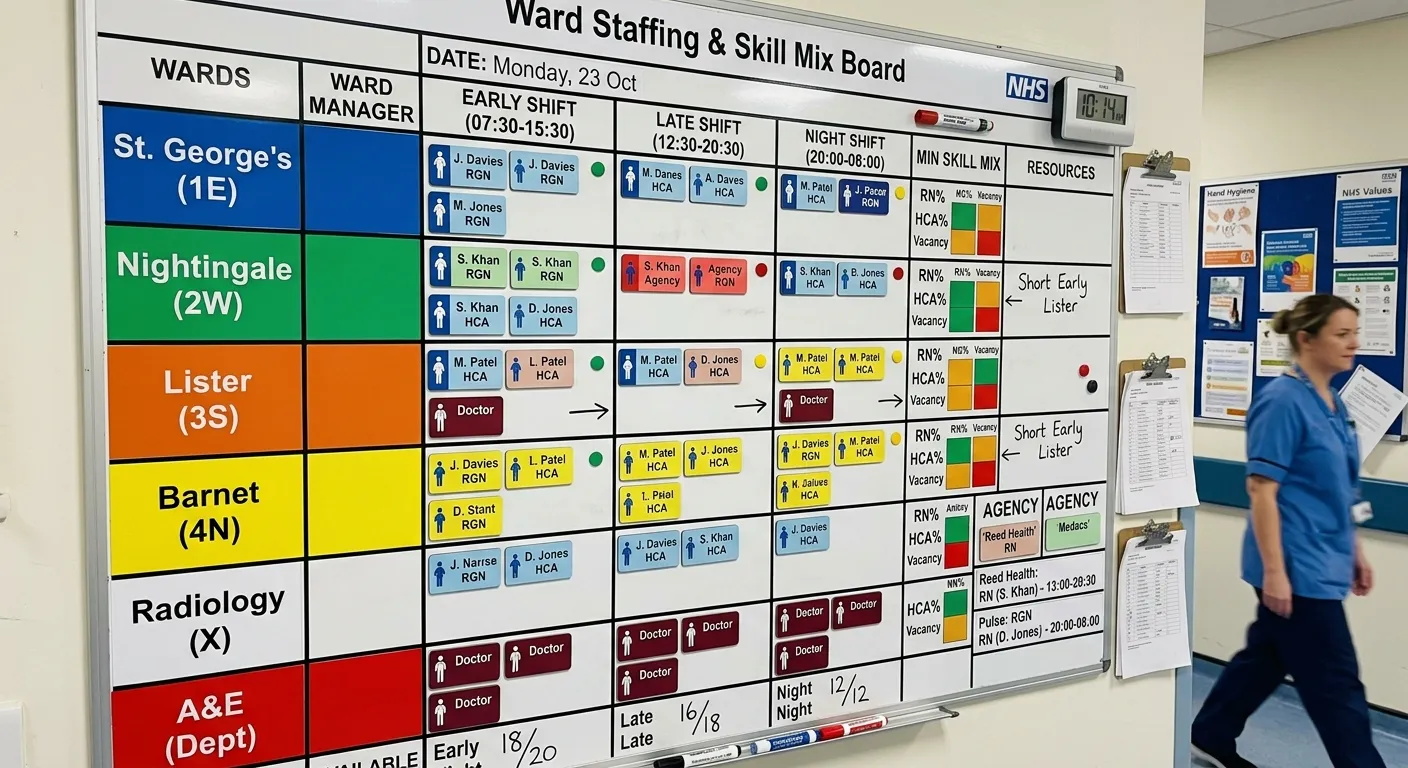
The trust creates a “surge readiness matrix” 10 weeks before the event. Instead of asking “How many nurses do we need?” it asks: “Which clinical domains are most exposed if we lose two senior nurses, one band 6 coordinator, and one radiographer?” This reframes staffing from headcount to competency coverage. For each domain, the team defines a minimum viable roster, a target roster, and a contingency roster. The minimum roster is the absolute clinical safety floor. The target roster is the normal service level. The contingency roster is the escalation position if demand rises or multiple staff become unavailable.
The Trigger Event
By 08:00 on the Saturday of the bank holiday, the trust records a higher-than-forecast A&E presentation rate, two unplanned maternity admissions, and a delayed discharge backlog on the medical wards. The internal bank has already offered 68% of available shifts, but the remaining gaps are concentrated in experienced band 5 nurses and one specialist palliative care rota. The agency partner is asked to fill three night shifts and two day shifts, with preference for staff who have worked at the trust before.
The Operational Response
The command centre activates Level 2 of the contingency ladder. A senior charge nurse reallocates two float nurses from a lower-acuity ward, while the agency supplies two familiar nurses and one health care assistant. The trust uses a pre-agreed uplift rate for the bank holiday, so finance approves the cover within minutes rather than through a lengthy exception process. Ward managers receive a written handover note for each agency worker, including patient acuity, escalation contacts, and any local safety concerns.
A Practical Contingency Ladder
- Level 1 – Optimise internal resources: Publish available bank shifts, open voluntary overtime, and confirm annual leave cancellations where clinically safe.
- Level 2 – Redeploy with skill-mix protection: Move float staff between wards only when the receiving ward has a named supervising clinician and the sender ward remains above its minimum safe roster.
- Level 3 – Activate familiar agency cover: Request agency staff who have previously worked at the trust, reducing orientation time and improving confidence in local protocols.
- Level 4 – Expand geographic sourcing: Ask the agency to recruit from neighbouring regions and offer reasonable travel or accommodation support where policy allows.
- Level 5 – Escalate to operational risk management: If the minimum roster cannot be met, senior clinicians and managers must formally assess service reduction, transfer, or emergency cover options.
The value of this ladder is that it prevents improvisation under pressure. Each level has a clear owner, a decision threshold, and an expected response time. In the case study, the trust avoided emergency service suspension because agency cover was requested at Level 3, not after a ward had already become unsafe. The post-event review showed that the cost of familiar agency cover was higher than internal bank shifts, but lower than the estimated cost of delayed discharges, overtime for permanent staff, and reputational damage from missed targets. This is the practical meaning of the NHS Staff Bank Holiday World Cup: not a single staffing problem, but a chain of linked operational decisions that must be managed together.
Agency Staff Bank Holiday Pay: A Worked Decision Framework
One of the most common causes of friction during peak staffing is not the availability of workers, but the ambiguity around what they are paid and when that payment is approved. A clear framework prevents trust managers, agency consultants, and finance teams from operating on different assumptions. The table below sets out practical scenarios that are frequently encountered during holiday and event-driven staffing periods.
| Scenario | What Typically Applies | Manager Action |
|---|---|---|
| Permanent staff or internal bank working a bank holiday | Trust policy usually determines whether the worker receives time off in lieu, enhanced pay, or a combination. The rate depends on local terms and conditions. | Confirm policy in writing before the shift is published and ensure payroll receives the correct holiday code. |
| Agency worker with less than 12 weeks’ service | Pay is set by the agency contract, but it must meet national minimum wage requirements. Bank holiday uplift may be offered as a commercial incentive rather than a strict AWR entitlement. | Ask the agency to state the exact hourly rate, uplift, and payment date in the shift confirmation. |
| Agency worker after the AWR qualifying period | Basic pay and conditions should align with a comparable permanent worker, including enhanced bank holiday pay if permanent staff receive it. | Review the framework rate card and check that the agency invoice reflects the agreed parity terms. |
| Emergency shift accepted on short notice | Additional premiums may apply for late cancellation, last-minute acceptance, or extended shift duration. | Agree thresholds in advance so that finance can approve without delaying the shift. |
A useful rule is to treat agency staff bank holiday pay as a procurement, payroll, and workforce wellbeing issue at the same time. If workers are unsure whether they will be paid fairly for a holiday shift, they are more likely to decline. If managers are unsure whether the rate is compliant, they may delay approval. If finance is unsure whether the invoice will be correct, payment may be held back. The result is avoidable instability in a period when stability matters most.
Example: A Pre-Agreed Holiday Shift Rate Card
A trust and its preferred staffing partner agree the following structure for a bank holiday weekend during a major sporting event:
- Standard weekday shift: £24.50 per hour.
- Bank holiday shift: £29.50 per hour.
- Night shift with bank holiday premium: £34.00 per hour.
- Shift accepted within four hours of start: £38.00 per hour.
- Shift cancelled by the trust less than two hours before start: minimum payment equivalent to four hours.
These rates are published internally, shared with ward managers, and embedded into the agency’s booking platform. The result is faster approvals, fewer disputes, and a stronger perception of fairness among temporary workers.
Compliance Checkpoints Before the Holiday Period
- Confirm which shifts attract bank holiday premium and which are treated as normal roster days.
- Ensure the agency has recorded the worker’s qualifying period correctly.
- Verify that enhanced pay rules are consistent with permanent staff terms where AWR parity applies.
- Pre-approve an emergency budget line for short-notice holiday cover.
- Agree invoice validation rules with finance so that holiday uplifts are not rejected automatically.
- Provide workers with a written summary of holiday pay terms at booking.
How to Evaluate Your Temporary Staffing Partner During Peak Events
A specialist agency should be judged not only on whether it can fill a shift, but on whether it can fill the right shift, at the right time, with the right compliance and the right experience. During an NHS Staff Bank Holiday World Cup scenario, the difference between a good supplier and a poor supplier can be measured in clinical risk, staff morale, and operational reputation. A structured scorecard makes that difference visible before the next peak period.
Core Metrics to Track
- Fill rate: The percentage of requested shifts successfully covered within the agreed timeframe.
- Time to fill: How quickly the agency confirms a worker after the shift is released.
- Repeat worker percentage: The share of agency staff who have previously worked at the trust.
- Compliance completeness: Whether DBS, right to work, immunisation status, and mandatory training are verified before deployment.
- Shift cancellation rate: How often confirmed workers cancel, and how quickly the agency re-fills.
- Invoice accuracy: Whether holiday uplifts, premiums, and hours are billed correctly first time.
- Escalation responsiveness: How quickly the agency resolves on-shift issues or absent staff.
- Worker satisfaction: A short feedback score from agency staff after each placement.
Weighted Scoring Example
Trusts can apply simple weights to reflect what matters most during peak events. A suggested model for holiday staffing is:
- 30% Fill rate and time to fill
- 20% Compliance and credential accuracy
- 15% Repeat worker familiarity
- 10% Cancellation management
- 10% Invoice accuracy
- 15% Worker and manager satisfaction
This scoring approach gives procurement teams a defensible basis for continuing, improving, or replacing a supplier. It also helps agencies understand exactly what “good” looks like in a high-pressure NHS environment.
The best agencies do not simply respond to vacancies. They help the trust reduce the number of vacancies that become urgent. They provide early availability data, flag holiday demand patterns, and offer pre-booked staff blocks. They also communicate honestly when a shift is difficult to fill, rather than leaving the ward manager to discover the gap two hours before the roster starts. For more on building this kind of supplier discipline, see our guide to staffing solutions and top staffing agencies.
Communication, Wellbeing, and the Human Side of Peak Staffing
Even the best roster plan can fail if the people executing it are not informed, supported, and protected. During a major holiday and sporting event, staff may feel that their personal time is being taken for granted. Agency workers may feel like temporary outsiders. Permanent staff may feel pressure to cover for colleagues who have already been stretched for weeks. The operational response must therefore include a strong human factors layer.
The 24-Hour Communication Playbook
A structured communication plan should cover the day before, the day of, and the day after a high-pressure bank holiday shift. The day before, ward managers confirm the roster, identify any agency staff arriving for the first time, and prepare a short handover note. The day of, a named point of contact is available for agency workers, especially during shift changes. The day after, managers collect feedback from staff and update the next holiday plan.
- Send a clear “what to expect” message to all staff, including transport advice, local event impact, and expected workload.
- Give agency workers a named supervisor, a ward phone number, and a digital induction pack.
- Use a simple colour-coded status for each shift: confirmed, at risk, filled, or escalated.
- Hold a five-minute safety huddle at each shift change, including agency staff.
- Record near-misses or integration issues so that the next event is managed better.
Protecting Wellbeing Without Reducing Safety
It is tempting to ask permanent staff to work extra shifts during a holiday surge, but that can create a false sense of resilience. A worker who accepts a second shift may be present physically but impaired cognitively. Fatigue, stress, and reduced vigilance increase clinical risk, especially in high-acuity environments. A safer approach is to build a mixed model: use internal bank where appropriate, protect permanent staff from excessive overtime, and bring in agency cover to create breathing space.
This also improves retention. Agency staff who feel respected, properly briefed, and paid correctly are more likely to return. Permanent staff who see that the organisation is willing to invest in cover are more likely to trust the rota process. Over time, that trust becomes a strategic asset for the trust.
Post-Event Debrief: Turning Experience into Preparedness
The learning does not stop when the holiday weekend ends. A structured debrief should involve nursing, medical, allied health, operational, finance, and HR representatives. The question is not only “Did we get through it?” but “What would we do differently next time?”
- Compare forecast demand with actual demand by service line.
- Review which shifts were filled by internal bank, agency, or redeployment.
- Identify where pay approvals delayed cover.
- Record which agency workers became trusted repeat staff.
- Update the contingency ladder with real thresholds.
- Agree one or two practical improvements for the next event.
This creates a continuous improvement cycle. Each holiday becomes a rehearsal for the next, and each staffing model becomes more accurate, more compliant, and more humane.